AI Product Concept · Human-Centered Design · Rapid Prototyping
CogniSense → CogniWise
Exploring how AI and data could make hidden cognitive signals visible, understandable, and actionable
CogniSense began as a speculative exploration of hidden cognitive states: signals such as attention, comprehension, memory, emotion, cognitive load, and other changes that people cannot always directly perceive. Across multiple prototypes, the idea was explored in two contexts — adaptive learning and cognitive wellness — connected by one product question: what if technology could help people understand signals that are normally invisible to them?
Interactive Product Experiences
Explore the prototypes
CogniWise Web
Full screen ↗CogniWise Lovable
Full screen ↗Explore both prototypes directly — scroll, click, and navigate. Prototype content is conceptual and not a validated clinical system.
Product Thesis
01
Invisible Signals
02
Make Them Perceptible
03
Translate Into Context
04
Guide Human Action
01 · The Inspiration
What if humans could perceive changes in brain health that our natural senses cannot detect?
Part of the broader inspiration for CogniSense came from seeing repeated stories of people experiencing sudden neurological events such as strokes, sometimes resulting in paralysis, memory loss, or lifelong disability after they had appeared outwardly healthy.
Those stories prompted a speculative question: are meaningful changes occurring inside the brain or body that people simply cannot perceive directly?
The Human Limitation
Our senses reveal some states — but not all of them.
Hunger, pain, temperature, and fatigue can produce sensations we recognize. Many cognitive, neurological, and physiological processes, however, are not directly perceptible in the same way.
The Future-State Vision
Imagine a new sense for cognitive wellness.
Could future sensing, data, and AI systems make otherwise invisible signals understandable enough that people become more aware of changes in their cognitive and physiological state?
Product Vision
Give people greater visibility into hidden cognitive states — then translate that visibility into context they can understand.
02 · CogniSense
The first exploration: Learning Resonance
The CogniSense prototype explored the hidden-state idea through learning. Instead of assuming every learner should absorb information through the same interface, pace, and presentation style, the concept asked whether an AI experience could respond to differences in the learner's internal state.
The concept called this state Learning Resonance — the alignment of attention, comprehension, memory formation, and emotion during learning.
Attention Stability
Whether focus is sustained or becoming fragmented.
Comprehension Depth
Whether meaningful understanding appears to be forming.
Memory Formation
Whether knowledge is beginning to stick and become retrievable.
Emotional Alignment
Whether emotional state supports or disrupts the learning experience.
Adaptive Experience
CogniSense explored adapting the learning interface, pace, and presentation style using different knowledge representations, including structured frameworks, narrative progression, and interactive reasoning.
03 · The Broader Insight
The deeper opportunity was not limited to learning
The learning prototype surfaced a broader product idea: people continuously generate signals about attention, cognitive demand, emotion, fatigue, and wellness, yet those signals are difficult to understand as a coherent picture.
That led to a second design exploration: instead of using hidden cognitive state only to adapt learning content, what might an interface look like if its primary purpose were to help a person understand their cognitive and wellness context itself?
CogniSense
Adapt the experience to the cognitive state
Explored how hidden learning states might inform interface, pacing, and knowledge presentation.
CogniWise Exploration
Make the state itself understandable
Explored a broader dashboard experience for bringing cognitive and wellness-related concepts into a unified, interpretable view.
04 · CogniWise Product Exploration
Turn invisible signals into a comprehensible daily view
The CogniWise dashboard prototype explores how multiple cognitive and wellness concepts could be brought together rather than shown as disconnected data points. The interface includes circulation, hydration, stress, cognitive load, an overall daily score, and contextual recommendations.
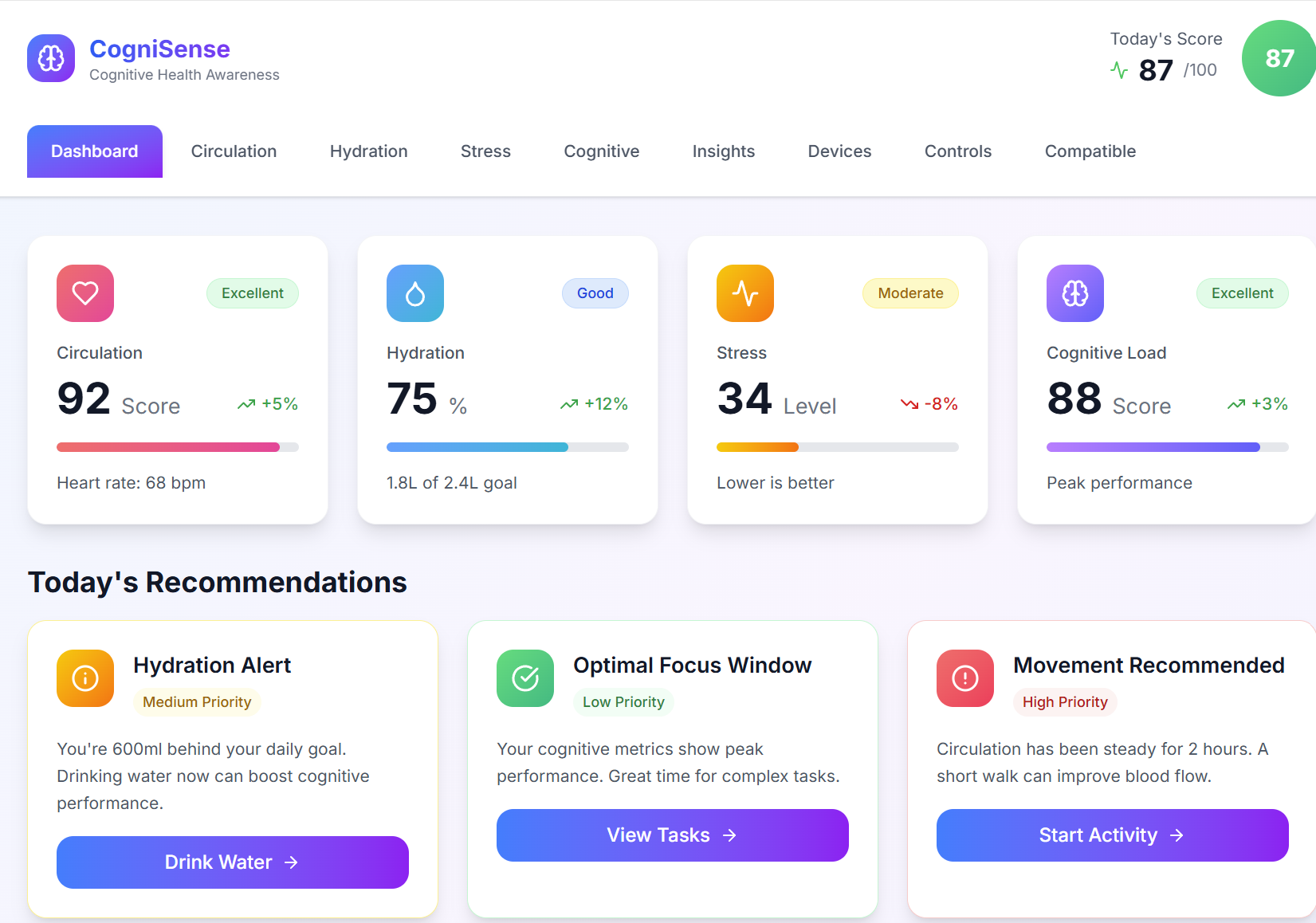
CogniWise exploratory dashboard. Values, scores, indicators, and recommendations shown in the prototype are illustrative product concepts, not validated clinical measurements.
05 · Product Logic
Signal → context → understanding → action
The design challenge was not simply to create another dashboard. The more interesting question was how a product might translate complex signals into information a person could actually understand without increasing cognitive overload.
01
Sense
Imagine future systems capable of capturing relevant cognitive or physiological signals.
02
Unify
Bring otherwise fragmented indicators into one coherent experience.
03
Interpret
Translate information into understandable context rather than unexplained metrics.
04
Guide
Surface contextual wellness suggestions while keeping the user in control.
06 · Human-Centered AI
More data is not automatically more understanding
A cognitive product creates an unusual UX challenge: presenting too many indicators can itself increase cognitive burden. The interface therefore explores hierarchy, summarization, contextual explanation, and recommended next actions instead of treating raw measurement as the final product.
Reduce Overload
Prioritize the information a user needs rather than displaying every possible signal.
Explain the Signal
Pair indicators with context so the interface communicates meaning, not only numbers.
Preserve Human Agency
Use AI and data to support awareness and decisions rather than presenting the system as an unquestionable authority.
07 · Iterative Prototyping
From abstract idea to interactive product experiences
The project moved through multiple design and prototyping environments rather than stopping at a presentation. That made it possible to explore different interfaces, information architectures, interactions, and ways of communicating the underlying concept.
CogniSense
Speculative AI learning concept centered on Learning Resonance.
Figma Make
AI-assisted interface exploration and rapid UX prototyping.
Lovable
Additional rapid product iteration around the broader CogniWise experience.
Deployed Web App
Interactive dashboard used to make the evolved concept tangible.
08 · What This Project Demonstrates
Translating an ambiguous human problem into an AI/data product experience
Problem Discovery
Starting with an ambiguous human problem and reframing it as a product opportunity.
AI Product Thinking
Exploring AI as an interpretation and personalization layer rather than simply adding an AI feature.
Data Product Design
Thinking through how multiple signals could become an understandable product experience.
Human-Centered UX
Designing around cognitive load, explanation, context, and user agency.
Rapid Prototyping
Using Figma and AI-assisted development environments to move quickly from idea to interactive experience.
Product Evolution
Testing the same underlying hidden-state thesis across learning and cognitive-wellness contexts.
09 · Responsible Framing
A future-state concept, not a diagnostic system
CogniSense and CogniWise explore what future AI, sensing, data, and interface technologies might make possible. The prototypes do not establish that the displayed indicators can predict stroke, diagnose neurological conditions, or provide clinically validated health assessments.
Any real-world medical implementation of this vision would require validated sensing methods, clinical evidence, privacy and security controls, appropriate regulatory review, and involvement from qualified healthcare professionals.
Project note: CogniSense and CogniWise are speculative product and prototype explorations. Cognitive, neurological, physiological, wellness, scoring, and recommendation elements shown in these experiences are conceptual and are not presented as validated medical measurements, diagnoses, stroke-prediction capabilities, clinical outcomes, or medical advice.